
An appliance error code identifies a condition the control system detected, not necessarily a failed part. Searching “what does appliance error code mean” is a useful first step, but a code can mean different things across brands and models. A heating fault, for example, may involve the element, sensor, wiring, or control board.
An unfamiliar code, a missing manual entry, or conflicting search results can make the next step unclear. The code alone usually can’t confirm which component has failed. Check its meaning against the appliance’s exact brand and model, then consider the symptoms and when the code appeared.
This article explains how to verify a code, distinguish a detected fault from a confirmed component failure, and choose a safe next diagnostic step. It also shows how an appliance error code database such as CodeFix can support your lookup. Treat database guidance as a reference, not a substitute for model-specific documentation or hands-on testing.
Key Takeaways
- Understanding what does appliance error code mean starts with treating it as a detected condition, not proof that a specific part has failed.
- Consider the connection between operating conditions, sensor inputs, control responses, and displayed codes to understand why several causes may fit one fault.
- Code meaning depends on appliance type, brand, and model. Don’t apply a definition from a different unit.
- Record the displayed code, identify the exact model, and compare a reliable reference with the symptoms and timing.
- Use only model-approved, low-risk checks. Repeated errors or internal testing may require qualified service.
What does an appliance error code mean?
An appliance error code is a diagnostic signal that reports a condition detected by the appliance’s control system. It narrows the area to investigate, but it doesn’t prove that one specific component has failed. A code related to heating, for example, may point to an abnormal heating condition without identifying whether the cause is a sensor, heating element, wiring fault, or control issue.
So, what does appliance error code mean in practice? It means the appliance detected something its programming treats as abnormal or requiring attention. The display is a diagnostic clue, not a repair verdict. Interpret it using the definition for the exact appliance model and what the appliance was doing when the code appeared.
What information does an appliance error code provide?
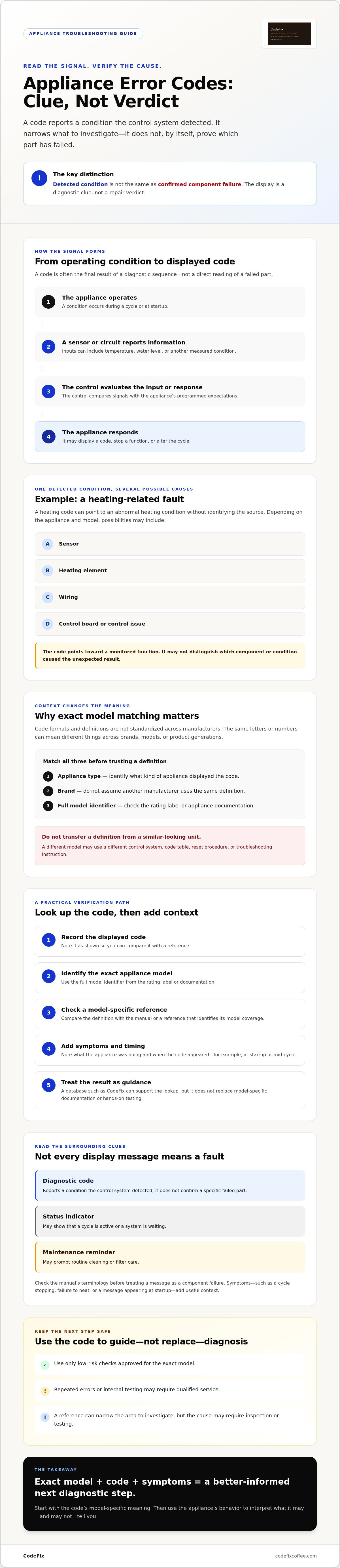
Appliance controls compare operating conditions with expected inputs or responses. A sensor may report temperature, water level, or another measured condition to the control board. If the reading or system response falls outside the programmed range, the control may display a code or change how the appliance operates.
This diagnostic process has some similarities to a Power-on self-test (POST), a term for checks performed by a computer during startup. Appliance checks and code triggers vary by model, so POST isn’t a universal description of how appliances diagnose faults.
Not every display message signals a fault. A status indicator may show that a cycle is active or a system is waiting. A maintenance reminder may prompt routine cleaning or filter care. Check the manual’s terminology before treating a message as a component failure. Symptoms add context: note whether the appliance stopped mid-cycle, failed to heat, or displayed the message at startup. Those details can help distinguish among possible causes.
Why the appliance brand and model matter
Code formats and definitions aren’t standardized across appliance manufacturers. The same letters or numbers can identify different conditions on different brands, models, or product generations. Even appliances from one manufacturer may use different control systems and code tables.
Record the full model identifier before looking up a code. Find it on the appliance’s rating label or in its documentation, then match the code to that exact model or a clearly applicable model range. A search result for a similar-looking appliance isn’t confirmation. Don’t transfer a code definition, reset procedure, or troubleshooting instruction from another model. Verify it against model-specific documentation or a reference that identifies its coverage.
How appliance error codes connect to sensors, symptoms, and components
A displayed code is usually the end of a diagnostic sequence, not a direct reading of a failed part. The appliance operates under a particular condition, a sensor or circuit reports information to the control board, and the appliance’s programmed logic responds. If the input or expected response falls outside its operating criteria, the control may display a code, stop a function, or alter the cycle.
For example, a temperature sensor may report a reading the control interprets as outside the expected range. A water-level signal may not change as expected during filling, or drainage may take longer than the control allows. Motor operation can also be monitored through electrical or feedback signals. These examples describe general diagnostic relationships, not specific code definitions. The exact trigger depends on the appliance model.
How sensors and control boards trigger diagnostic codes
The control board evaluates signals, but it doesn’t necessarily know which physical cause produced an unexpected result. A sensor reading may be inaccurate, a circuit may be open or intermittent, or the monitored system may not reach the expected condition. To understand what does appliance error code mean for a particular unit, match the code to its model-specific documentation, then compare the stated condition with the appliance’s behavior.
Access to diagnostic and repair information is part of the broader Right to Repair movement. Such information can support troubleshooting, but a code description alone doesn’t replace inspection or testing of the appliance.
Why one code can have more than one possible cause
Several faults can produce the same detected condition. A drainage-related indication, for instance, could be associated with restricted water flow, a pump issue, a wiring or connector fault, or a control problem. The code points toward the monitored function, but it may not distinguish among the causes.
Symptoms add evidence. Note whether the appliance stops during a particular cycle stage, makes an unusual sound, leaves water behind, or shows the code intermittently. A consistent symptom pattern can help narrow the checks, but it may not identify a component by itself. Wiring continuity, sensor output, mechanical movement, and control operation may need to be tested before selecting a replacement part.
A code reports a condition detected by the appliance; only appropriate testing can confirm which component, if any, has failed. After recording the model and code, use a model-matched appliance error code database as a diagnostic reference. Treat listed components as possibilities to verify, not automatic replacement instructions.
Why appliance error codes differ by brand, model, and appliance type
Appliance error codes don’t follow one industry-wide system. Manufacturers choose their own formats and diagnostic logic, so a letter-and-number combination may indicate different conditions on different products. A similar display isn’t evidence of a shared definition.
Model revisions matter, too. A newer generation may use different sensors, control-board logic, or component layouts than an earlier model with a similar name. That can change both the conditions the appliance monitors and how it reports them. To determine what does appliance error code mean for your unit, match the displayed code to the complete model identifier, not just the brand or appliance category.
Why a similar code may mean something different
Code formats can vary by manufacturer and product generation. A lookup for another model may describe a different monitored condition, even if the characters match. Start with the owner’s manual or a verified reference that identifies the applicable model. General troubleshooting guidance for major appliances also points readers toward the owner’s manual for model-specific information.
How appliance type changes the diagnostic context
Appliance design shapes what its control system monitors. The examples below describe broad diagnostic contexts only; they aren’t code definitions or diagnoses for a particular unit.
| Appliance type | Possible diagnostic context |
|---|---|
| Espresso machine | Water flow, temperature, or pressure-related operation |
| Dishwasher | Water fill, drainage, or heating during a cycle |
| Dryer | Heat, airflow, or drum operation |
| Oven | Temperature sensing, heating, or control response |
These systems differ, so the same displayed characters shouldn’t be interpreted across appliance types. Even within one category, component layout and control logic can vary. A dishwasher’s drainage monitoring, for example, isn’t interchangeable with a dryer’s airflow or drum monitoring.
Use category-level information to orient your search, then verify the code against the exact model’s documentation. Treat broad database entries as a starting point, not a substitute for model-specific checks. Brand and appliance references can provide code definitions, but those definitions must be matched carefully.
How to look up and verify an appliance error code
A reliable lookup starts with accurate records. Small differences in a code, model number, or operating condition can lead to an incorrect result. Use this sequence before deciding what to check or replace.
- Record the complete code. Photograph the display, including letters, numbers, punctuation, and any flashing pattern. Don’t rely on memory or omit characters that seem incidental.
- Identify the appliance. Write down the brand and full model number from the appliance label or its documentation. Similar model names may refer to different control systems.
- Check a model-matched reference. Start with the owner’s manual. A searchable appliance error code database such as CodeFix can be a useful next lookup, but confirm uncertain meanings and instructions against documentation for the exact model.
- Compare the code with the symptoms. Note when it appears, what the appliance was doing, whether it repeats, and any recent changes. A match between a listed condition and a symptom supports the lookup, but doesn’t prove a specific component has failed.
What to record before searching
Capture the display while the code is visible. Record whether it appears at startup, during a particular cycle stage, or after the appliance stops. Note observable symptoms, such as a cycle ending early or water remaining in the appliance, along with any recent changes in use or setup. These details help you tell an applicable reference from a coincidental match.
How to assess whether a code lookup applies
Prefer a source that names the appliance brand and model or clearly states which models its information covers. If the manual and a database differ, don’t assume the broader result applies. Check model-specific documentation before following a reset or repair instruction. A search result that matches only the code characters isn’t enough to verify the meaning.
Keep initial checks external and observational: read the display, note operating behavior, and inspect only areas the manual identifies as user-accessible. Disassembly, live electrical testing, and internal component checks are different tasks. Don’t attempt them based only on a code description. Consult the model’s safety instructions and seek qualified service if the required procedure is unclear.
Before choosing a repair, confirm the full code, exact model, model-specific definition, and matching symptoms. To compare a recorded code with reference information, search the appliance error code database.
What to do after you understand the appliance error code
Use the code to guide the next check, not to choose a replacement part automatically. Confirm what does appliance error code mean for the exact model, then follow only troubleshooting steps that the appliance manual or verified model-specific guidance identifies as appropriate for the user.
When a basic check is reasonable, and when to stop
Low-risk checks may include inspecting an accessible filter or confirming a setting, but only when the manufacturer’s instructions permit them. Disconnect power or water only as directed by the manual. Don’t open energized equipment, bypass a safety device, or remove panels to investigate an internal fault based on a code alone.
Stop and seek qualified service if the code returns after an approved check, the cause remains uncertain, or diagnosis requires internal electrical or mechanical testing. A repeated code can indicate that the monitored condition persists; it still doesn’t identify the failed part by itself. Follow any model-specific safety instructions, especially if the appliance shows signs of an electrical or water-related problem.
Use a verified diagnosis to plan the next step
Before proceeding, compare the reported condition with the appliance’s symptoms, age, operating state, and the checks already completed. If testing confirms a component fault, consider whether the repair is practical and whether the correct procedure and parts information are available. Don’t order or replace a part solely because it appears in a code lookup as a possible cause.
CodeFix is an independent diagnostic reference. Its database entries provide code meanings, possible component causes, and troubleshooting guidance; they don’t replace model-specific verification or hands-on testing. CodeFix doesn’t provide in-person appliance repair or sell replacement parts directly. Treat an entry as an informational starting point, not a repair guarantee.
For a final decision, rely on evidence from the exact appliance, not the code alone. If the recommended next step involves a procedure you can’t safely verify or perform, leave internal diagnosis to a qualified professional. To check the code against the appliance brand and model, look up the appliance error code in CodeFix’s searchable database.
Use the Code to Make a Better-Informed Next Step
An appliance error code is a diagnostic clue, not confirmation that a specific part has failed. Its meaning depends on the exact brand and model, and symptoms help put the code in context. Verify the definition before following troubleshooting instructions or choosing a repair.
If you're still asking what does appliance error code mean for your appliance, start with its full model identifier and the exact displayed code. CodeFix is an independent, searchable appliance diagnostic reference covering major brands and categories including espresso machines, dishwashers, dryers, and ovens. Its entries can help identify possible causes and troubleshooting guidance, but model-specific documentation and appropriate testing remain essential.
Look up your appliance error code in the CodeFix database to find a relevant reference for your unit. Check the code, model, and symptoms together to choose a more informed next step.
Frequently Asked Questions
What does an error code on an appliance mean?
An appliance error code reports a condition its control system has detected. The signal may relate to a monitored function, such as heating, water flow, or motor operation. It narrows the diagnostic search but doesn’t confirm that a particular part has failed. Check the code definition for the exact model, then compare it with what the appliance was doing and any symptoms you observed.
Can the same appliance error code mean different things on different models?
Yes. Manufacturers use different code systems, and definitions can vary between models from the same brand. A model revision may also use different components or control logic. Match the code to the appliance’s full model number, not only its brand or product category. Use the owner’s manual or a reference that identifies the applicable model, and don’t assume a similar code from another unit applies.
Does an appliance error code identify the part that needs replacing?
Usually not by itself. A code identifies a detected condition or problem area, while several causes may produce that condition. For example, an abnormal temperature reading could involve a sensor, wiring, a heating component, or the control system. Treat any listed part as a possibility to investigate. Confirm the cause through model-appropriate checks or testing before ordering or replacing a component.
How do I find the meaning of my appliance error code?
Record the complete code, including letters, punctuation, and any flashing pattern, and photograph the display if possible. Find the appliance’s full model number, then check its owner’s manual or a reliable model-specific reference. Compare the listed condition with when the code appears and the symptoms. CodeFix provides a searchable appliance error code database, but check its guidance against model-specific documentation.
What should I do if my appliance error code is not in the manual?
Verify that you have the correct manual for the full model number and recorded the display accurately. Search a reference that states its brand and model coverage, such as CodeFix’s database, and compare the result with the appliance’s behavior. If the meaning or recommended action remains unclear, don’t rely on a code match from a different model. Seek model-specific guidance before attempting a repair.
Can I reset an appliance error code myself?
Only follow a reset procedure if the owner’s manual or verified instructions for the exact model recommend it. A reset may clear a displayed message, but it doesn’t necessarily correct the condition that triggered it. Note the code first, then follow the documented steps. If the code returns, stop repeating resets and investigate the underlying fault using approved checks or qualified service.
Is it safe to keep using an appliance that displays an error code?
Safety depends on the code, symptoms, and manufacturer guidance. Check the manual for instructions about continued operation. Stop using the appliance if you notice smoke, a burning smell, unusual heat, leaking, or signs of electrical trouble; follow the manual’s safety steps and seek qualified assistance. If there are no apparent hazards, don’t assume continued use is safe until the code’s model-specific meaning is verified.
