
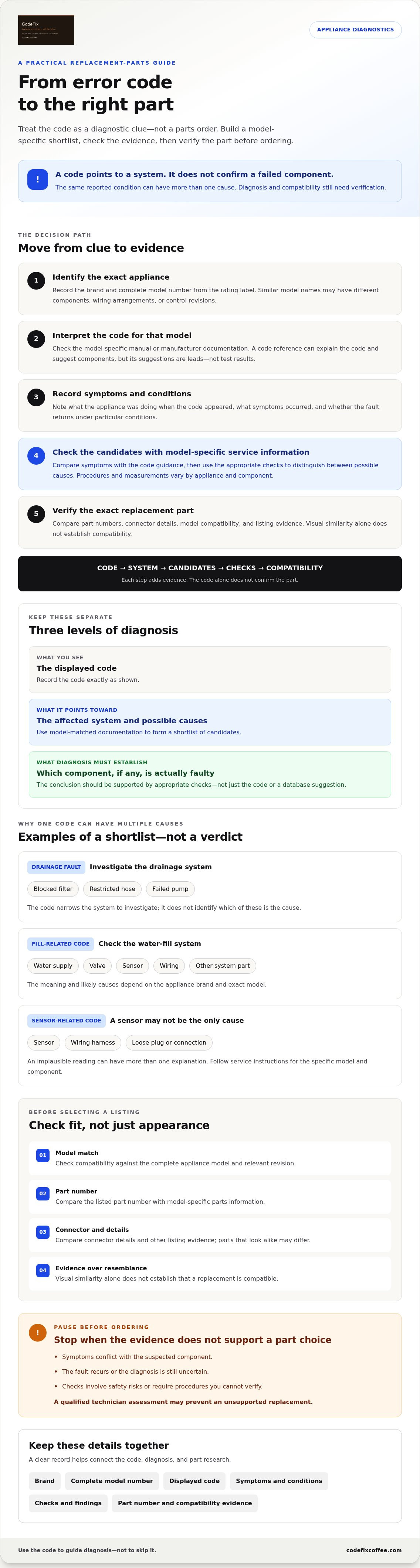
The part named by an appliance error code may not be the part that failed. An appliance error code replacement parts guide should treat the code as a diagnostic clue, not a parts order. A drainage fault, for example, can come from a blocked filter, restricted hose, or failed pump. The code narrows the system to investigate, but it doesn’t confirm the component. Parts that look alike can also differ by model, revision, or connector.
Ordering the wrong part adds cost without necessarily fixing the appliance. Start by recording the complete model number and checking the manufacturer’s documentation. Then compare the code guidance with the symptoms and appropriate physical or electrical checks. CodeFix’s error-code database can help explain a code and identify suspected components, but the diagnosis and compatibility still need verification. This guide walks through how to move from code to evidence, assess a parts listing, and decide when to stop and seek qualified help.
Key Takeaways
- Separate the system reported by the code from the component confirmed to have failed.
- Use this appliance error code replacement parts guide to build a model-specific shortlist, then narrow it with appropriate diagnostic checks.
- Compare part numbers, connector details, and listing evidence. Visual similarity alone doesn’t establish compatibility.
- Use service information for the exact model when testing, since procedures and measurements vary by appliance and component.
- Pause before ordering if symptoms conflict, faults recur, or diagnosis involves safety risks. A technician assessment may prevent an unsupported replacement.
Before ordering an appliance error code replacement part, confirm what the code tells you
An error code is a clue, not confirmation that a specific component has failed. It may point to a circuit, sensor, motor, or operating condition, and several problems can produce the same reported condition. A fill-related code, for example, may involve the water supply, a valve, a sensor, wiring, or another part of the system. The meaning and likely causes depend on the appliance’s brand and exact model.
Keep three things separate: the code displayed, the system it identifies, and the component confirmed faulty by diagnosis. A database entry can explain a code and list suspected parts, but those suggestions are leads, not test results. This distinction is central to an appliance error code replacement parts guide: ordering based on the code alone can mean paying for a part that still works.
A code narrows the diagnostic path. Model-specific checks help determine whether a component is actually faulty.
What an appliance error code can and cannot confirm
A sensor-related code may indicate an implausible reading, but the sensor itself isn’t the only possible cause. Depending on the appliance and its service instructions, diagnosis may also require checking the wiring harness and connections. A loose plug, damaged conductor, or poor connection can affect the signal. Don’t apply generic measurements or procedures. Use service information for the specific model and component.
Use code guidance to form a shortlist, then compare it with the symptoms and appropriate test results. A suspected part becomes a stronger candidate when the available evidence supports that diagnosis.
Why the exact appliance model matters
Record the complete model number from the appliance rating label before looking up the code. Similar model names can conceal different components, wiring arrangements, or control revisions. Production revision may also affect the correct interpretation. The broad category of Home appliance covers many types of equipment, but code definitions aren’t interchangeable across them.
Check the model-specific manual or manufacturer documentation before interpreting the code or relying on a parts suggestion. An appliance error-code database such as CodeFix can be a useful starting reference, but verify each code-to-component association against documentation for the exact brand and model. Confirm the model number before moving from diagnosis to parts research.
Turn the appliance error code into a shortlist of parts to investigate
Use the code to organize your investigation, not to select a replacement immediately. Narrow the possibilities in stages:
- Identify the appliance: Record the brand and complete model number from the rating label.
- Look up the code: Use a reference that matches the appliance type, brand, and model. Don’t assume the same code means the same thing across a brand’s product range.
- List possible causes: Note the affected system and candidate components, keeping each as a possibility until checked.
- Compare and test: Record symptoms and operating conditions, then use model-specific service information to identify checks that can distinguish between candidates.
A searchable appliance error-code database, such as CodeFix’s appliance error-code reference, can connect a code with suspected components and repair guidance. Treat that information as a starting point. Verify each code-to-component association against documentation for the exact model before relying on it. Any brand-specific association should be checked against the relevant model documentation, too.
Build a model-specific shortlist from the code
Keep the brand, full model number, displayed code, and circumstances together in one record. Consult the model-specific manual or manufacturer documentation, then list candidate components and the evidence needed to assess each one. For example, a sensor might remain on the shortlist until the service procedure helps distinguish a sensor fault from a wiring or connection problem. The right to repair discussion covers broader questions about access to parts and information. It doesn’t replace model-specific diagnostic instructions.
Compare the code with symptoms and operating conditions
Write down what the appliance was doing when the code appeared. Did it fail to start, stop mid-cycle, leak, overheat, or behave intermittently? Note whether the fault happens at a particular cycle stage or returns only under certain conditions. These details can make one possible cause more plausible than another, but they don’t confirm a failed part.
Record recent changes, such as a power interruption, cleaning, or installation work. Treat them as context, not proof of cause. If a fault appeared after cleaning, for instance, it may be worth checking affected connections or components. The timing alone doesn’t establish that anything was damaged.
A suspected part is a diagnostic lead. Evidence from the correct model-specific checks is needed to confirm a failure. Use this as the working rule for an appliance error code replacement parts guide: refine the shortlist with symptoms and test results before checking parts compatibility.
Verify the suspected appliance part before ordering
Before treating a shortlisted component as failed, look for evidence that supports the diagnosis. The right check depends on the appliance, component, and service procedure. A visual inspection may reveal a damaged housing or corroded terminal. Other faults may require connector checks or electrical measurements. No single inspection applies to every appliance.
Use the manufacturer’s service information for the exact model and follow its safety instructions. Disconnect power before inspection when instructed. Don’t remove panels or reach into assemblies unless the procedure is within your ability. Some appliances also involve water, heat, moving parts, or stored electrical energy. If safe isolation steps aren’t clear, stop.
Check the component and its surrounding connections
Where access is safe and permitted, look for visible damage, loose connectors, corrosion, blocked paths, or signs of leakage. Check related wiring and connections as well as the suspected part. A fault reported by a circuit can originate in a connector or harness, not necessarily in the component suggested by the code.
Don’t bypass a safety device to see whether the appliance will run, and don’t operate it with exposed electrical assemblies. If inspection requires dismantling a sealed assembly, disturbing safety components, or working near energized parts, leave that step to qualified service.
Know when a multimeter or technician is required
A multimeter is useful only when you know the correct test, meter setting, connection points, and isolation procedure. Follow model-specific service instructions. Resistance or voltage values can vary by component and model, so don’t apply a generic reading or infer failure from an unverified target.
Live electrical testing, high-voltage systems, sealed assemblies, or uncertain results are reasons to stop and seek qualified diagnosis. A measurement taken under the wrong conditions can mislead the diagnosis or create a safety hazard. If the result doesn’t match the documented procedure, don’t order a part based on guesswork.
Evidence from testing that follows the correct model-specific procedure is stronger than an error code alone. Apply that standard in an appliance error code replacement parts guide: confirm the fault before sourcing a component, and pause if the required test exceeds your tools or experience.
Match the replacement part to the appliance model and listing
Once the suspected failure is verified, match the candidate part to the appliance’s complete model number and the identifiers in the listing. Compare the manufacturer’s documentation with the seller’s description. Don’t rely on a photograph or a broad claim such as “fits this brand.” Similar-looking components may differ electrically or mechanically.
Which identifiers to compare on a replacement listing
Check the appliance model and any production or revision information available in its documentation. Then compare the component part number, description, connector configuration, and dimensions where specified. Manufacturer identifiers, compatible replacement identifiers, and seller descriptions aren’t interchangeable by default. A seller’s compatibility claim is useful evidence, but verify it against model documentation or request clarification if identifiers conflict.
| Check | Compare against | What to verify |
|---|---|---|
| Appliance model | Rating label and manufacturer documentation | Complete model number and documented revision details |
| Part number | Existing component and model documentation | Exact identifier, or documented replacement identifier |
| Component description | Service information and listing | Same function and assembly, not just a similar name |
| Connector | Documentation and listing evidence | Configuration and connection details match |
| Listing evidence | Seller’s compatibility information | Supported models, part condition, and clear return terms |
Missing or conflicting details are a reason to pause, not guess. Ask the seller to confirm compatibility for the exact model and part identifier before purchase. A photo can help compare shape, but it can’t establish connector pinout, electrical rating, dimensions, or fit within an assembly.
How to assess a third-party parts listing
Check whether the listing names compatible models and clearly states if the component is new, used, or refurbished. Review return terms and seller support before ordering. Those terms belong to the seller, not CodeFix. The parts-matching step in an appliance error code replacement parts guide should end with a match supported by identifiers and documentation, not visual resemblance alone.
CodeFix provides error-code information and may refer readers to third-party parts or tool vendors. It doesn’t sell replacement parts directly, and it may earn a commission from qualifying third-party referrals. For a model-specific diagnostic reference before comparing listings, look up your appliance error code.
Decide whether to order the part, get help, or stop troubleshooting
Before placing an order, check that the appliance identity, diagnosis, and listing support the same conclusion. In this appliance error code replacement parts guide, the next step is to order when the evidence aligns, verify when information conflicts, or stop when further testing exceeds safe DIY limits.
Use an order, verify, or stop decision
- Order: The complete appliance model matches the documentation, the code meaning is supported for that model, symptoms or test results support the suspected component, and the listing provides credible compatibility evidence.
- Verify: The model revision is unclear, part identifiers don’t match, listing details are incomplete, or test results conflict with the suspected failure. Resolve those gaps before purchasing.
- Stop: Diagnosis requires live electrical testing, unsafe access, or procedures beyond your training. Repeated faults or an uncertain cause also justify technician assessment before buying parts.
Don’t treat a replacement as confirmed simply because the code returns after a reset. A recurring fault can point to an unresolved underlying condition, an incorrect diagnosis, or another issue in the same system. Replacing more parts without new evidence can add expense without resolving the problem.
Continue from diagnosis to a reliable next step
If you seek a technician assessment, provide the complete model number, displayed code, circumstances when it appeared, symptoms, and checks already performed. This record helps distinguish what the appliance reported from what has actually been verified. If the diagnosis is supported but you’re unsure whether repair makes economic sense, consult repair-versus-replacement and repair-cost guidance. That decision is separate from confirming part compatibility.
CodeFix provides appliance error-code information that can help locate model-relevant guidance and suspected component details. It may refer readers to third-party parts and tool vendors, but it doesn’t sell replacement parts or provide in-person repair service. Confirm vendor terms and compatibility with the vendor.
Before sourcing a component, look up your appliance error code and compare the guidance with your model documentation. Use the result to inform your next step, not as a substitute for diagnosis.
Make the Next Parts Decision Evidence-Based
An error code narrows the diagnostic path, but it doesn’t confirm a failed component. Record the complete model number, check the code against model-specific documentation, and compare the suspected fault with symptoms and appropriate test results. Before ordering, verify that the part number and listing support compatibility with that exact appliance.
This appliance error code replacement parts guide offers a process for moving from code lookup to an evidence-based sourcing decision. Stop and seek qualified assessment if diagnosis remains uncertain or requires unsafe testing. CodeFix offers searchable diagnostic information for multiple appliance types and major brands. Its code guidance can connect fault indications to suspected components and third-party sourcing referrals. CodeFix doesn’t sell parts directly or provide repair service.
Look up your appliance error code on CodeFix before comparing replacement listings. Use the result as a diagnostic reference, then confirm the code meaning and part compatibility for your model. With those checks complete, you can make your next decision with clearer evidence.
Frequently Asked Questions
Can an appliance error code tell me exactly which part to replace?
Usually, no. A code identifies a fault condition or affected system, not a confirmed failed component. The same code may have several causes, such as a damaged sensor, wiring fault, blocked mechanism, or control issue. Record the exact appliance model, compare the code with the symptoms, and use model-specific tests before ordering. Treat database suggestions as diagnostic leads, not proof that a particular part needs replacement.
How do I find the correct replacement part using an appliance error code?
Start with the brand and complete model number, then look up the code in a model-specific reference. Use the result to identify candidate components, not to place an order immediately. Compare the suspected part with service documentation, and inspect or test it only when safe. Then check the part number and stated compatibility against the seller listing. This appliance error code replacement parts guide approach helps you avoid relying on code labels or product photos alone.
What information do I need before ordering an appliance replacement part?
Have the complete appliance model number, displayed error code, and suspected component description available. Check whether manufacturer documentation identifies a model revision or production difference. Compare the component’s part number and connector arrangement with the documentation and listing, including the seller’s stated compatible models. If identifiers are missing or conflict, pause. Ask the seller to verify fitment or seek qualified diagnosis rather than assuming that appearance or a matching brand is enough.
Are replacement parts interchangeable between appliance models?
Not necessarily. Appliances with similar names or appearances can use different components, connectors, control revisions, or specifications. A seller may identify a part as compatible with selected models, but confirm that claim against your complete model number and reliable documentation. A shared brand or component description doesn’t establish compatibility. If the listing omits model details or contradicts manufacturer information, verify with the seller before purchase.
Can I replace an appliance part myself after an error code appears?
It depends on the component, appliance, confirmed diagnosis, and your experience. Some visual observations may be straightforward, but electrical measurements, live testing, sealed assemblies, or access to hazardous areas can require appropriate training. Follow the manufacturer’s safety instructions and disconnect power before inspection when directed. If you can’t confirm the test procedure or interpret its result, stop and seek qualified service instead of replacing parts by trial and error.
Should I order a part before testing the suspected component?
Order only when reliable, model-specific evidence supports the diagnosis and the listing matches the appliance. A code may point to a circuit or symptom with several possible causes. Comparing symptoms, checking accessible connectors, and following safe, documented tests can help distinguish them. Don’t perform a test if its procedure or safety requirements are unclear. If testing isn’t safe or the results remain uncertain, get qualified diagnosis before purchasing a component.
Does CodeFix sell appliance replacement parts directly?
No. CodeFix provides an appliance error-code database with diagnostic information and may refer readers to third-party vendors for parts or tools. CodeFix doesn’t control those vendors’ listings, availability, purchase process, or return terms, so check those details with the seller. Review any affiliate disclosure associated with a referral. CodeFix also doesn’t provide in-person appliance repair or handle manufacturer warranty claims.

